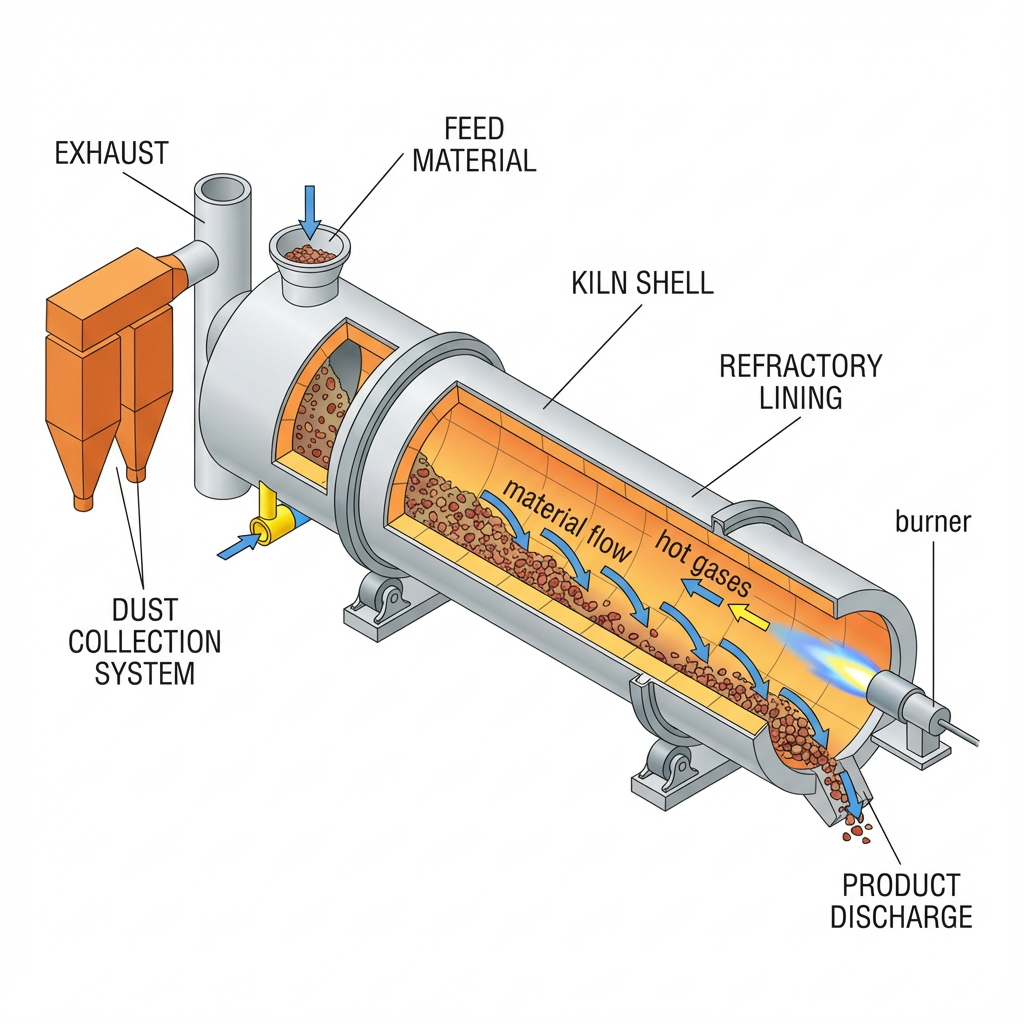
1. Understanding Your Raw Material Characteristics
Before any rotary kiln design begins, the physical and chemical properties of the raw material must be fully analyzed.
Key parameters include:
Moisture content and fluctuation range
Particle size distribution
Chemical composition (CaO, SiO₂, Al₂O₃, Fe₂O₃, etc.)
Grindability and abrasiveness
Ignoring real production variability often leads to:
Ring formation
Unstable kiln operation
Reduced output capacity
A properly engineered rotary kiln must be designed around the material, not the other way around.
2. Capacity Design vs. Sustainable Production
Many investors focus on nameplate capacity, but sustainable kiln output depends on:
Heat balance calculation
Kiln diameter and length ratio
Rotational speed optimization
Residence time of material
Oversized or undersized kiln designs result in:
A professional kiln supplier should always provide process calculation data, not just equipment drawings.
3. Fuel Flexibility and Energy Efficiency
Energy cost is one of the largest operating expenses in rotary kiln systems.
Modern kiln lines should consider:
Coal and petcoke compatibility
Alternative fuel readiness
Burner design and flame shape control
Combustion air distribution
A flexible fuel strategy significantly improves:
Operating stability
Long-term cost control
Environmental compliance
4. Refractory Design and Kiln Shell Protection
Refractory failure is a common cause of unplanned shutdowns.
Key design factors include:
Thermal load distribution
Kiln shell deformation analysis
Expansion allowance and shell ovality
Refractory material selection by zone
Proper refractory and shell design can extend lining life by 30–50%, reducing downtime and maintenance cost.
5. Supporting Systems: Preheater, Cooler, and Dust Control
A rotary kiln never operates alone.
Its performance depends heavily on upstream and downstream systems:
Cyclone preheater efficiency
Grate or rotary cooler performance
ID fan selection and pressure balance
Dust collection and emission control
System-level optimization ensures:
6. EPC vs. Equipment-Only Supply: What Should You Choose?
For many cement and mining projects, choosing between EPC turnkey solutions and individual equipment supply is critical.
EPC solutions are recommended when:
Project management resources are limited
Process integration risks are high
Faster commissioning is required
Equipment-only supply may suit experienced operators with strong in-house engineering teams.
Conclusion: Engineering Comes Before Equipment
A rotary kiln is not a standard product.
It is a process system, customized to raw material, capacity requirements, fuel strategy, and local operating conditions.
Successful projects start with:
Technical evaluation
Process design
Risk identification
—not just quotations.
About LVSSN Engineering
LVSSN Engineering specializes in rotary kiln systems, cement production lines, and mineral processing plants, offering:
Process design & engineering
Rotary kiln & supporting equipment
EPC turnkey solutions
Technical upgrades and optimization
🔗 Learn more: https://www.lvssn.com/